Download
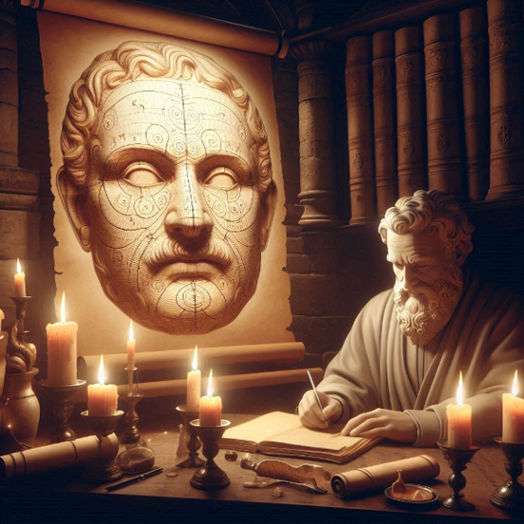
Physiognomy is of great antiquity, and in ancient and medieval times it had an extensive literature.
There is evidence in the earliest classical literature,
including Homer and Hippocrates, that physiognomy formed part of the
most ancient practical philosophy.
The earliest-known systematic treatise on physiognomy
is attributed to Aristotle. He examined the characters derived from the different features,
and from color, hair, body, limbs, gait, and voice.
Among the Latin classical authors Juvenal, Suetonius, and Pliny the Elder
refer to the practice of physiognomy.
While the earlier classical physiognomy was chiefly descriptive, the later medieval studies
particularly developed the predictive and astrological side,
their treatises often digressing into prophetic folklore and magic.
Arabian writers such as the alchemist ar-Razi and Averroûs
also contributed to the literature of physiognomy.
Physiognomy also is extensively treated by such scholars as Avicenna.
Physiognomy has also been used as a kind of divination
and is often associated with astrology.
Lavater's studies in physiognomy
drove him to search for demonstrable traces of the divine in human life.
Physiognomy, which claims to find correspondences between bodily features
and psychological characteristics, often makes use of supposed similarities.
The same structure underlies the use of astrological tables in which animals, plants, and minerals,
as well as human personality traits, are associated with the birth signs of the zodiac
or planets.
Predictive methods of fortune-telling include astrology
and numerology. Fortune-telling as a process of character analysis can take
such forms as physiognomy (study of facial characteristics), graphology (study of handwriting),
phrenology (study of contours on the skull), and palmistry (study of lines on the palm of the hand).
In the 18th and 19th centuries, physiognomy was used by some
of its proponents as a method of detecting criminal tendencies.
Many bigots and racists still use physiognomy to judge character
and personality.
Phrenology,
the study of the conformation of the skull as indicative of mental faculties and traits of character,
enjoyed great popular appeal well into the 20th century.
The system of Franz-Joseph Gall was constructed by a method of pure empiricism.
Some of the traits that he presumed to detect were "criminal."
Lombroso tried to discern a possible relationship between criminal psychopathology
and physical or constitutional defects.
Among these anomalies, which he termed stigmata, were various unusual
skull sizes and asymmetries of the facial bones.
See physiognomy as a branch of physiology.
In the 1920s, Dr Edward Vincent Jones, a US Superior Court Judge, fascinated by the similarity
between people he met in thousands of courtroom encounters,
began a study of physiognomy traits.
Reviewing earlier literature on the subject, Jones determined
to resolve the conflicting ideas he found there.
Through repeated observations, he arrived at sixty-four physical traits
that he deemed accurate indicators of character.
It is on Jones's work, which he called "personology."
Classification into physiognomy types is outside the realm of personology
but can be found in other systems. Joel Friedlander described seven body types
that have their origins in endocrinology: solar, lunar, venusial, mercurial, jovial, martial and saturnine.
Also during the 1930s, personality studies began to consider
the broader social context in which a person lived
and cultural pressures in personality characteristics.
For example, the American anthropologist Margaret Mead
in her book "Sex and Temperament in Three Primitive Societies"
showed that masculinity is not necessarily expressed
through aggressiveness and that
femininity is not necessarily expressed through passivity and acquiescence.
Physiognomy is now regarded as overly simplistic
because most personality characteristics are manifested at different times in
response to different situations.
In the 1960s, the American psychologist named Paul
Ekman got his start in the face-reading business
and he discovered that the face is such an
extraordinarily efficient instrument of communication that there must be
rules that govern the way we interpret facial expressions.
Ekman had established that expressions were the universal products of evolution. There were
fundamental lessons to be learned from the face, if you knew where to look.
In order to become a good "face reader" you had to know a lot.
Not only the knowledge accumulated for centuries,
but also the psychology and diversity of facial traits determined by nationality and character.
Today, physiognomy is whidely used and it is being
studied in the best known colleges and universities.
Participants will learn to identify and analyze the features of the face
and gestures that characterize personality traits.
There is a wide selection of literature describing physiognomy.
USEFUL LINKS
LoveToKnow 1911.
Encyclopaedia Britannica.
The Sceptic's Dictionary by Robert Todd Carroll.
Phrenology & lavater, physiognomy, art and racial science by Ross Woodrow.
Reading Bumps and Faces; Phrenology and Physiognomy by Jerry Bergman.
Online Course: Face Reading (Physiognomy) instructor Joel Lawson.
Judging character from the face by Therese M Donnelly.
Physiognomy Of Women Aryabhatt Astrology Services.
How To: Read Faces
by Steve Richer.
The Naked Face by Malcolm Gladwel.
Foresee Future
Foresee your future through palm reading & face reading.
Male sex appeal lies in face shape by Laura Clout (www.telegraph.co.uk).
The main conclusion that we can make from the history of physiognomy is that there is a great amount of empirical evidence that
correlates facial features and character traits.
Let's try to use this methods in practice,
overlooking the debates whether physiognomy
really is a true science or charlatanry.
| Download (3300kb) | Screenshots | More info...| See videos...
|