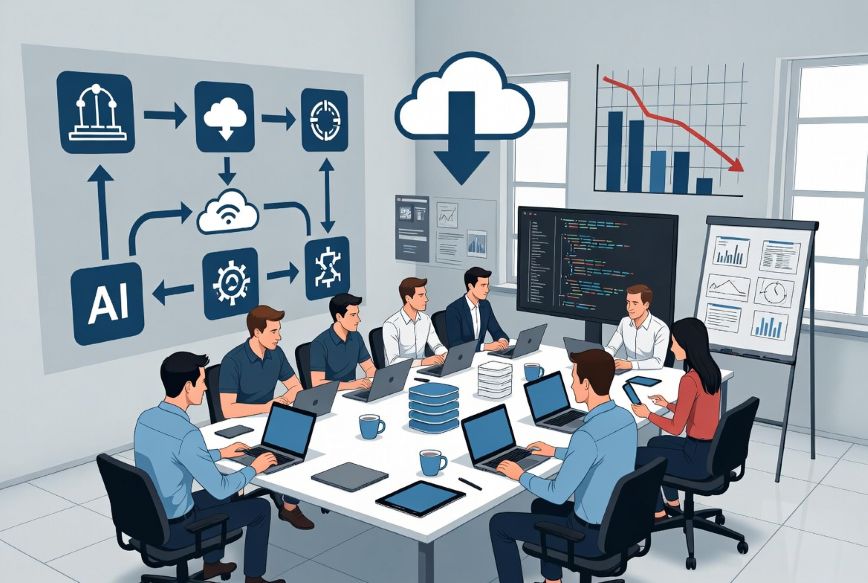
Global software investment tends to contract during economic recessions, as capital markets tighten and venture funding slows across technology sectors. McKinsey research on innovation cycles notes that downturns often reduce discretionary tech spending, forcing companies to reassess priorities and delay expansion projects. At the same time, World Bank data shows that periods of global economic stress consistently influence digital infrastructure investment, especially in emerging markets where funding sensitivity is higher. These shifts do not stop software development, but they reshape its direction, pace, and efficiency focus.
These dynamics are closely tied to broader shifts in the technology economy, where financial pressure directly influences product strategy and engineering decisions. A clear example of this relationship can be explored through insights on Economía de la Tecnología, which highlights how macroeconomic instability affects digital industries and innovation capacity. When uncertainty rises, software companies are pushed to rethink how they build, price, and scale products. Rather than slowing innovation entirely, economic pressure often redirects it toward efficiency and sustainability.
Economic Pressure on the Software Industry
During downturns, one of the most visible effects in the software sector is the tightening of funding. Startups experience reduced access to venture capital, while publicly traded tech firms face pressure to improve profitability. According to Crunchbase News, global venture funding dropped significantly during recent economic slowdowns, particularly affecting early-stage companies that rely on continuous investment cycles. As capital becomes scarce, hiring slows and product roadmaps are shortened.
Layoffs also become more common in this environment. Data from Layoffs (dot) fyi shows that major tech companies reduced workforce sizes in multiple waves during recent downturns, reshaping the talent landscape. This leads to a redistribution of skilled engineers into smaller teams and startups, often accelerating leaner operational models. Despite the challenges, these shifts force organizations to prioritize essential features and eliminate low-impact development work.
From Constraint to Innovation Pressure
Economic stress, while disruptive, often creates a strong push toward disciplined engineering practices. Companies begin to question expensive infrastructure choices and redundant system complexity. Instead of scaling aggressively, software teams focus on stability, optimization, and return on investment per feature. Gartner has observed that during periods of economic uncertainty, organizations increasingly prioritize measurable efficiency gains over experimental expansion.
This environment also encourages product consolidation. Multiple overlapping tools are merged into unified platforms, reducing operational costs. As a result, software ecosystems become more streamlined, even if the pace of new feature launches slows temporarily. The industry begins to favor durability over rapid iteration, a shift that has long-term implications for software architecture design.
Rise of Lean Software Development
One of the clearest responses to economic pressure is the adoption of lean software development principles. Teams aim to build only what delivers direct value, minimizing waste in both code and resources. This approach reduces infrastructure costs and shortens release cycles. Engineering teams rely more heavily on modular design, allowing them to adjust features without rebuilding entire systems.
Lean development also improves resilience. Smaller, focused codebases are easier to maintain during staffing reductions or budget cuts. In this way, financial constraint becomes a catalyst for cleaner architecture and more intentional product planning. Rather than slowing innovation, it refines it.
Growth of Automation and Cloud-Based Models
Automation becomes a critical response to workforce limitations during downturns. Companies invest in tools that reduce manual workloads, from automated testing pipelines to AI-assisted development environments. These technologies help maintain productivity even with smaller teams. IDC reports that spending on automation and AI-driven software tools tends to rise even during broader IT budget contractions, highlighting their strategic importance. At the same time, deployment models continue to evolve, with increased interest in progressive web apps (PWAs) in modern software development, which allow companies to deliver app-like experiences without the heavy cost of maintaining separate native applications.
This shift strengthens the role of cloud-based and subscription systems. Instead of large upfront investments, businesses prefer flexible pricing structures that align costs with usage. This improves financial predictability while allowing software providers to scale services more efficiently. Over time, these combined changes reinforce a more adaptive and resilient digital ecosystem shaped by both technological progress and economic constraint.
A More Efficient Software Future
Economic downturns consistently reshape the direction of digital innovation. While they introduce uncertainty, they also encourage discipline, efficiency, and architectural maturity. Companies that adapt successfully tend to emerge with stronger systems and more sustainable business models. The technology economy, influenced by cycles of expansion and contraction, becomes more balanced as a result.
Ultimately, financial pressure does not halt software innovation. Instead, it refines it. Lean development, automation, and cloud-based ecosystems demonstrate how constraint can lead to smarter engineering decisions. As the industry evolves, these adaptations continue to define a more resilient and efficient software landscape shaped by economic reality rather than unchecked growth.